
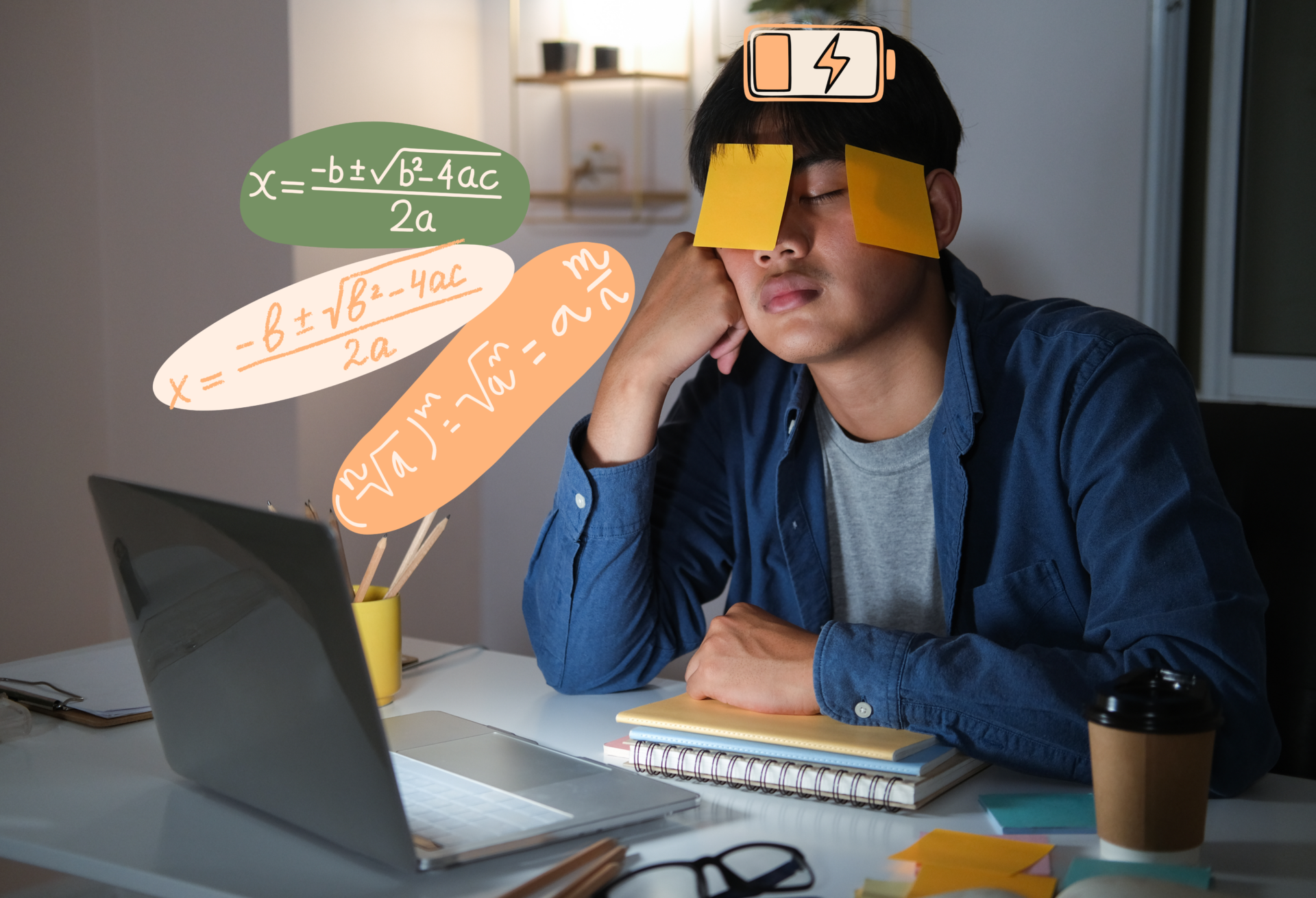
In high school, it's often said that it's not a big deal. That it's a time when we have time, friends, holidays, and that real stress will come later, in adulthood.
But many students experience it completely differently. Not as an easy period, but as long-term pressure that subtly builds up every day until it becomes difficult to tell where normal fatigue ends and true exhaustion begins.
And that's precisely where something emerges that isn't talked about much yet — student burnout.
Story: "The worst part was that I had no reason to be tired... but I was all the time."
Tomáš is a sophomore in high school. On the outside, he seems normal. He goes to school, plays sports occasionally. Nothing that would appear to be a problem at first glance.
But inside, it began to break down slowly and subtly.
"It started by me studying more than others. Then even more. And then I realized that even when I had free time, I couldn't relax," he says.
It wasn't one specific moment, but rather a long period where he felt like he constantly had to catch up. Learning gradually stopped being about learning itself. It just became a way to avoid stress.
The most surprising thing to me was that I had no reason to be exhausted, and yet I was.
Things that used to entertain him gradually began to fade. Games, sports, friends. Not because they disappeared, but because there was no longer room for them in his head.

What exactly is student burnout?
Student burnout is a state of long-term psychological and emotional overload that occurs when a person is under prolonged pressure without adequate recovery.
It's not about laziness or not being able to handle school. It's more about the moment when the brain can no longer constantly operate in performance mode.
It typically manifests as learning losing its meaning, everything becoming just an obligation, and nothing bringing joy anymore. The person feels like they are operating on autopilot, without real energy.
And the most treacherous part is that it doesn't happen all at once. It develops slowly, until one day you realize that your "normal state" isn't actually normal anymore.
If someone recognizes themselves in this, it's not a failure. It's a signal that it's time to ease up the pressure. Not on performance, but on yourself.
"But you're just going to school..."
This is a sentence that can hurt more than it seems.
Because from the outside it can really look simple. School, a few tests, homework. But on the inside, it's often completely different.
Pressure for grades, parental expectations, entrance exams, the future, comparing ourselves to others, and the constant feeling that we should be doing more. And then there are social media, where it often seems like others are handling everything with no problems.
The result is a quiet inner pressure that says: you are not enough.
Even if we're going all out.
When is it no longer just normal tiredness?
Perhaps it's time to pay attention when fatigue doesn't disappear even after rest. Things that used to be enjoyable no longer make sense. Learning causes stress or resistance. We feel like we're not keeping up, even though we're constantly doing something.
And sometimes the most important signal is that we no longer feel joy or repulsion. Just emptiness.

What about it when it starts breaking?
There isn't one quick fix. Rather, it's small steps that gradually reduce pressure. It helps to take things off your plate where possible. Stop constantly comparing yourself to others, allow yourself moments where you don't have to solve anything, and most importantly, don't just talk about it in your head, but also out loud.
Sometimes, just admitting to yourself "this is too much" can be the start of a change.
You are not alone.
When it becomes too much, you don't have to handle it all by yourself. A school psychologist, someone close you trust, or professional help can assist you.
Asking for help is not an exaggeration or a weakness. It is a natural response to long-term overload, which, while not visible, is real.
Recommended literature
If this topic interests you, or if you see yourself in it, it might help to look at it a little more deeply.
- Emily Nagoski, Amelia Nagoski – Burnout: The Secret to Unlocking the Stress Cycle
- Christina Maslach, Michael P. Leiter – The Truth About Burnout
- Byung-Chul Han – The Burnout Society
- Katherine May Wintering
Burnout in high school doesn't mean we can't handle school or life. It means that for a long time, there was more than could be silently carried. And if you recognize yourself in this, it's not a failure. It's a signal that it's time to reduce the pressure. Not on performance, but on yourself.